

As published in Governing Magazine
Eying Expansion, Philadelphia’s Port Turns to a Homegrown Leader
Rich Lazer has built a career in government by “never burning a bridge.” As the new director of the Port of Philadelphia, he’s hoping to oversee its biggest expansion in decades.
Philadelphia, PA (August 25, 2026) – The United States is one of the world’s biggest importers of cocoa beans, and almost all of them come through the Port of Philadelphia. When Rich Lazer sees them, spilling out of burlap sacks as they’re carried from cargo ships to a pier shed on the Delaware River, he starts daydreaming about even more ships — this time full of coffee.
Lazer, a lifelong Philadelphian who’s held a string of public jobs, was named executive director of the Philadelphia Regional Port Authority in April. In that role, he’s responsible for executing a strategic plan the port adopted a few years ago, when Lazer was serving as one of its board members. The plan is about growth: More infrastructure, more ships, more cargo, more cruises, more jobs.
To oversee that kind of growth requires a mix of skills, political and managerial, many of which Lazer has developed during his time working for former Philadelphia Mayor Jim Kenney and later as head of the Philadelphia Parking Authority, one of the most reviled public institutions in the city. It requires credibility with port workers, which Lazer, who still lives in the port-adjacent South Philly neighborhood where he grew up, has been nurturing for years. And it requires a bit of direct appeal to potential port customers.
Ports are government entities that act like businesses. The Port of Philadelphia is akin to a landlord. It owns the land and manages the infrastructure of the port, and leases it to private port operators. It gets plenty of state grants, but also has to bring in lots of revenue. In his first few months as port director, Lazer has traveled around the country, speaking with customers and trying to drum up new business for Philadelphia. For instance, cocoa beans and coffee beans share many of the same shipping routes. If Philadelphia can handle 80 percent of the country’s cocoa imports, Lazer reasons, why can’t it bring in some coffee too?
“You have to build strong relationships with your customers and your cargo owners, and then you go out there and sell the port,” he says.
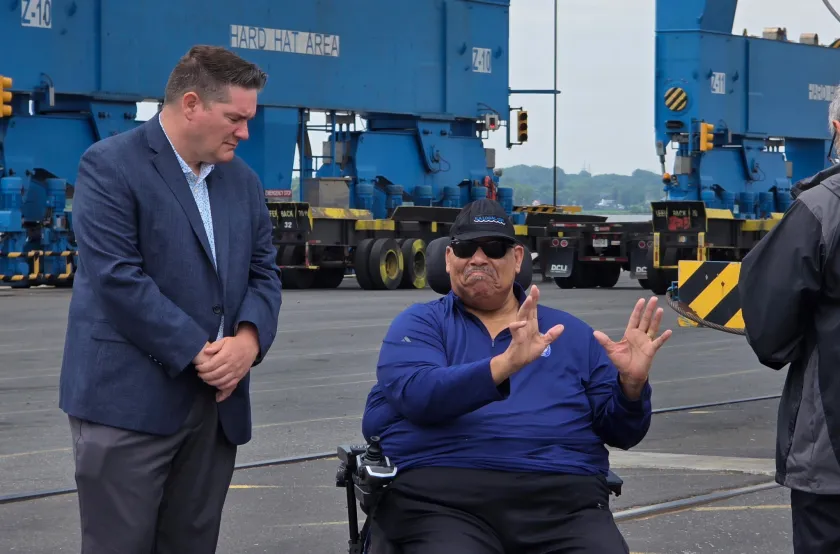
Rich Lazer, left, with International Longshoremen’s Union Local 1291 President Boise Butler Credit: Marty O’Rourke
A Career in Politics
The Port of Philadelphia, like many other ports, is an independent authority created by the state, which provides much of the funding for its infrastructure. Last year, for instance, Pennsylvania Gov. Josh Shapiro’s administration put $90 million into the port’s purchase of a 150-acre site adjacent to its South Philly facilities. It’s planning to use the site to expand its cargo capacity. It’s also additional storage for Hyundai, which ships new cars from South Korea to Philadelphia, where they’re stored on a giant riverside surface lot before being loaded onto big rigs and delivered to dealerships up and down the east coast. The port is planning to build two new berths in South Philadelphia, and needs more state funding, as well as state and federal permitting, to get it done. The PhilaPort board — of which Lazer, 41, has been a member for the last decade — cited his “vast experience in labor relations, operations management, stakeholder engagement, and complex negotiations” when announcing his selection to the top job in April. Lazer says he’ll lean on all the relationships he’s already built.
“One thing I try to do is never burn a bridge. You’re never going to be able to help everybody, but you always return phone calls and you always make an effort,” he told me. “When people see that you made an effort, you ran it up the flagpole and tried to make it work, that’s what matters to folks.”
Lazer’s grandfather worked as a stevedore at the South Philadelphia ports. Lazer grew up in the neighborhood right next to the river, which is called Pennsport. He was active in neighborhood civics as a kid, volunteering at his local rec center. Later he worked as an aide to City Councilman Jim Kenney. When Kenney became mayor in 2016, he named Lazer the deputy mayor for labor. Kenney also appointed him to the port board in 2016. He continued serving on the board after Cherelle Parker took over the mayor’s office.
In 2018 Lazer ran for Congress. He had worked in political offices and on campaigns before, but had never been a candidate himself. He came in third place in the Democratic primary, a loss that he doesn’t seem to regret.
“[Running for office] helped me in general — how I speak in different rooms,” he says. “The relationships I made were important. The experience that I got from it mattered. It helped me broaden my horizons.”
In 2022, toward the end of the Kenney mayoralty, Lazer was named executive director of the Philadelphia Parking Authority. People in Philadelphia, no matter what else they know about the government, know that the parking authority gives out parking tickets, and they tend to hate it passionately. That was true before Lazer’s tenure and it’s still true today.
But as director, Lazer managed to ever-so-slightly change the reputation of the agency. He stepped up enforcement of parking violations in bicycle lanes, which delighted local urbanists. He responded to neighborhood complaints about chronic sidewalk blockages. He oversaw the installation of speed cameras on Broad Street, a wide arterial that seems to invite dangerous driving. He even helped develop a new intercity bus terminal after a longstanding Greyhound terminal closed, a project that many other city leaders had fumbled. His tenure there earned him a spot in the “get-shit-done hall of fame,” as one local civic leader once said.
“Richie really established good working relationships with all kinds of stakeholders throughout the city. Those are very important, just so you can sort of align your goals and be able to reach out and call somebody,” says Beth Grossman, a Philadelphia Parking Authority board member. “We really began expanding our role.”
‘Like a Mini City’
Philadelphia’s port is known for the efficiency of its operations. It was recently ranked as the “most productive” port in the U.S. for the third year in a row. Lazer says that’s a credit to the port workers, something he boasts about as he travels around trying to attract more business. And many of the workers who do the heavy lifting on the docks are excited about Lazer’s appointment. They like that he’s a hometown guy with a family history at the port. They like that he’s well-connected politically. And as far as expansion goes, their interests are aligned.
“The name of the game is hours,” says Al Braun, the business manager for the International Longshoremen’s Association Local 1242 in Philadelphia.
What port workers want is to be listened to and understood, Braun says. Longshoremen have a lot of expertise, but it’s often passed down through generations. Braun played baseball in college and wanted to be a pitcher for the Philadelphia Phillies. When that didn’t pan out, he went to work at the ports, like his father had. He says Lazer has a stellar reputation among the workers.
“He’s got a history of success. He’s visible. He’s onsite. He’s accessible. He listens. He follows through. He takes action. He’s sharp. He’s direct,” Braun says. “He’s the right man for the job.”
Lazer says, when it comes to managing a complex institution like the port, it’s important to foster relationships with all the stakeholders, from stevedores and longshoremen on up to the governor. “It really is a trust thing,” he says.
Ports compete with each other, and some have geographic advantages. The Port of Wilmington, for instance, is about 30 miles downriver from Philadelphia, with a naturally deeper channel. A number of years ago, after a long advocacy campaign from port workers, the state of Pennsylvania put $130 million toward a $400 million plan to dredge the Delaware River near the Philadelphia port so it could welcome bigger ships. Once the wider ships started coming in, the port needed new cranes that could reach farther out into the water to pluck off the piled-up containers. The state helped pay for those too. A few years ago, Holt Logistics, one of the biggest private port operators in the area, sued to stop a planned expansion for a new container terminal at the Port of Wilmington, which might absorb business that would otherwise go to Philadelphia.
Ports also collaborate. Lazer says that he has had lots of conversations with his counterpart in Wilmington about ways to promote the Delaware River as a whole for shipping business. It’s about overall growth, rather than poaching business from another port.
“A port is like a mini city,” says Sang Yi, president and CEO of the American Association of Port Authorities. “Think about someone who would run a city: What kind of person would you want for that? It’s similar, but with a business mindset.”
Lazer says his goal in the job is to execute the vision that was in place when he started. That means getting the expansion, including the two new berths, through permitting, and starting construction next year. This month the port also announced it was moving its own headquarters to the Navy Yard in South Philly, with the intention of building a “maritime campus” there. Lazer wasn’t thinking about becoming the port director until the previous director, Jeff Theobald, started talking about retiring. But when Lazer describes the way he pitched himself to the board for the job of port director, it sounds a lot like Politics 101.
“It’s about building that coalition, building that support, and then just plowing forward,” he says. “You have to show milestones. As you make these improvements, it may be the littlest thing, but you have to promote it.”
I asked him if he thinks about running for office again some day.
“You never close the door,” he said. “You come to a job, you have a set of goals you want to accomplish. Hopefully you get done what you want to get done, and then you take a look at it from there.”